
 Social Psychologist & Personal Advisor
Salvation by Grace through Faith:
A Covenant Context

that Jesus set for receiving Salvation and Eternal Life, beginning with the Question:
Since the followers of Christ from 31 to 34 A.D. did not have the writings of Paul,
were the teachings of Jesus alone, sufficient to lead believers to Salvation?
Salvation & Eternal Life. Conclusions which come from the direct teachings of the Bible.
2 - The Works That I Do Shall Ye Do Also: Making a Saving Covenant.
3 - The Written Law of Christ: By Faith We Access Saving Grace.
4 - Out-of-Context Controversies: Clarifying Conundrums.
The Written Laws of Christ:
Infusing Works with Heartfelt Faith
Faithfulness that Opens Access to His Grace
The Law of the Spirit of Life..That we should worship God "in spirit" became a central theme of the New Covenant: "For as many as are led by the Spirit of God, they are the sons of God" (Romans 8:14). This emphasis upon following the inward dictates of "heart" and "Spirit" was the impetus that gave birth to a much misunderstood idea called "Spirit of the Law" -- a concept that suffers from two common misconceptions:
A) The term "Spirit of the Law" is not found in the scriptures. Paul spoke of "the law of the Spirit of life" (Romans 8:2), and taught "that we should serve in newness of spirit, and not in the oldness of the letter" (Romans 7:6). When taken out of context, this and other statements by Paul has led some to a second incorrect conclusion:
B) Living the so-called "Spirit of the Law" means that having a good inward intention is good enough, and that outward obedience to the written law is optional. This erroneous idea is further energized by another of Paul's "hard to be understood" (2 Pet. 3:16) statements:
“For he is not a Jew, which is one outwardly; . . . But he is a Jew,
which is one inwardly; and circumcision is that of
the heart, in the spirit, and not in the letter.”
(Rom. 2:28-29)
This declaration directly addresses the hypocrisy happening in those days: where some "scribes and Pharisees" (Matthew 23:27) complied with the technical terms of "the letter" of Moses's old law, and thus created an outward appearance of goodness. Jesus called such pretenders of righteousness:
"hypocrites . . . whited sepulchers, which indeed appear beautiful outward,
but are within full of dead men's bones, and of all uncleanness.”
(Matt. 23:27)
Paul called them “menpleasers” (Eph. 6:6) who offered outward “eyeservice” (Colossians 3:22) while inwardly motivated by "the praise of men more than the praise of God" (John 12:43).
Mere outward conformity to “the letter” (Romans 7:6) devoid of being “pure in heart” (Matt. 5:8) is not acceptable in Christ’s New Covenant. Living by "the law of the Spirit of life" means avoiding all hypocrisy of heart while continuing outward obedience to the Savior's admonitions:
"Verily, verily, I say unto you, He that believeth on me,
the works that I do shall he do also"
(John 14:12).
Christ's New Covenant calls for Outward & Inward Obedience. Jesus taught that the "first and great commandment" (Matt. 22:38) should be kept with "all thy heart, and with all thy soul, and with all thy mind, and with all thy strength" (Mark 12:30).
In this admonition, the Savior expressed the importance of both the outward and inward integrity of our efforts to love God and fellowmen -- that our love is whole and unified. So, living "the law of the Spirit of life" means that inward intents of “an honest and good heart” (Luke 8:15) with “all humility of mind” (Acts 20:19) are added to outward “strength” of compassionate acts and charitable service.
Jesus implored, "If ye love me, keep my commandments" (John 14:15). Obeying the commandments outwardly is still the standard of the New Covenant. By loving God and others with complete purity of heart, we infuse the "Spirit of life" (Rev. 11:11) into the strength of good works.
Christ's New Covenant calls for a different standard compared to the Law of Moses and the outward observance of the "letter." In contrast, Christ's New Covenant goes beyond merely refraining from, for example, the act of adultery; but also admonishes avoidance of lustful thoughts of committing adultery. This is just one example of living the so-called "Spirit of the Law" as opposed to the "letter."
The "oldness of the letter" (Romans 7:6) specifically refers to the Old Law established by Moses; in contrast, when lived according to His New Testament teachings, there really is no "letter" in the New Law declared by Christ. Why? Because obedience to "every word that proceedeth out of the mouth of God" (Matt. 4:4) must be lived with complete wholeness: "with all thy heart, and with all thy soul, and with all thy mind, and with all thy strength" (Mark 12:30).
The common misconception connected with "the law of the Spirit of life" (Romans 8:2) somehow means, that one does not actually have to obey certain laws outwardly -- some assume that complete wholeness is not required in certain instances.
Jesus gave an example where having good inward intent counted for much, compared with lavish outward acts of apparent righteousness. In His parable, a widow who has very little to give, yet gives her all, "two mites." And because she gave with pure intent, and would have given more if she had more, her small offering was esteemed as being larger than offerings given by the wealthy. Jesus said:
"Verily I say unto you, That this poor widow hath cast more in,
than all they
which have cast into the treasury:
For all they did cast in of their abundance;
but she of her want did cast in all
that she had, even all her living."
(Mark 12:43-44)
But notice in this example of inwardly good intentions, still, the widow gave more than just good intentions, she gave her all, just as the Lord requires: Heart, Might, Mind, Strength, and Soul -- according to the Law of the Spirit of Life.
Faithfulness Necessary But Not Sufficient. Paul taught the Romans an important principle:
"Therefore being justified by faith, we
have peace with God through our Lord Jesus Christ:
By whom also we have access by faith
into this grace wherein we stand."
(Romans 5:1-2)
In this same sermon, Paul established, "even so might grace reign through righteousness unto eternal life by Jesus Christ our Lord” (Rom. 5:21). Some assume that the "righteousness" spoken of in this verse, is our righteousness—and this is a likely interpretation in light of the following admonition from the Savior:
"Verily, verily, I say unto you, He that believeth on me,
the works that I do shall he do also."
(John 14:12)
Jesus established that true believers will "work the works of God" (John 6:28) and shine forth His Light directly through their "good works" (Matt. 5:16), and that only those that "doeth the will of my Father" will "enter into the kingdom of heaven" (Matt. 7:21). Given the clear declarations of Jesus, it is abundantly obvious that doing God's work and will is necessary—it represents our part of the "new covenant" (Hebrews 12:24).
However, it is ultimately His Righteousness that is first and foundational to obtaining eternal life. Why so? Because we are all beggars who have been bought by His precious blood—we have all fallen short of His glory (Romans 3:23) and do not possess power to be worthy of ourselves, apart from His saving grace. Nevertheless, our righteousness is required by the terms of the New Covenent—set forth by the Savior himself.
Our righteousness is made sufficient through His Righteousness--His Redeeming Grace. Because the faithful will be rescued by His Grace, some foolishly fall into faulty logic: if we will inevitably fall short, we might as well take advantage of Grace by indulging in sin for a season. This rationalizing mindset is not pleasing to Jesus.
The Savior taught integrity! He proclaimed that the "first and great commandment" (Matt. 22:38) should be kept with "all thy heart, ... all thy soul ... all thy mind, and ... all thy strength" (Mark 12:30). In this admonition, the Savior expressed that our heartfelt efforts to love God and fellowmen should be whole and unified.
The Grace of God. Grace reigns through righteousness (Rom. 5:21); and it is His Righteousness that is the “well of water springing up into everlasting life” (John 4:14). Further, it is the Savior who invites all to come and drink of “living water” and “never thirst” again (John 4:10-14).
While our loving Lord graciously provides the source of living waters, we must exercise our God-given agency to come to the Source and drink of “the fountain of the water of life” (Revelation 21:6). And as we drink, “the righteousness of the law [is] fulfilled in us, who walk not after the flesh, but after the Spirit” (Romans 8:4).
Through our heartfelt and faithful partaking of the waters of life and by His gracious giving of those merciful waters, the covenant is complete.
But even though we diligently strive in righteousness, our fervent faith and heartfelt efforts inevitably fall short; Paul taught, “For all have sinned, and come short of the glory of God.” (Rom 3:23). Therefore, our believing in Christ and working the works of Christ will ever be insufficient without His merciful giving of grace; hence, all "boasting ... is excluded," whether of good faith (Rom. 3:27-28) or good works (Eph. 2:9).
All humanity must humbly fall at the feet of the Master and pray that His Righteousness might save them; for He is the Source of “living water” (John 4:10, 11, 38) and He is the True Vine from which our fruits flourish. Without Him we “can do nothing” (John 15:5).
Grace will not Save the Servants of Sin. Sealed and sanctified by the atoning blood of Jesus Christ, the New Covenant is crowned by the Grace of God. But God never intended that his Grace would save those who willfully sin against his word, and fail to keep the explicit contigencies of the New Covenant. Paul warned: “What then? Shall we sin, because we are not under the law [of Moses], but under grace? God forbid” (Rom. 6:15). The Apostle continues:
“Know ye not, that to whom ye yield
yourselves servants to obey, his servants
ye are to whom ye obey; whether of sin unto
death, or of obedience unto righteousness. But God
be thanked, that ye were the servants of sin, but ye have
obeyed from the heart that form of doctrine
which was delivered you.”
(Rom. 6:16-17)
The previous passage summarizes three important truths:
A) That all mankind is accountable before God for “that form of doctrine”
that is delivered, whether it be by the written word, the spoken word,
or by the whisperingsof the Holy Spirit as the law written in the heart;
B) The law of the Spirit of life requires that “obedience unto righteousness”
be “obeyed from the heart;” and
C) Those who are the “servants of sin” and yield not to the written word,
the spoken word, or the promptings of the law written in the heart,
will “sin unto death.”
The Grace of God is extended to those who repent and faithfully do the works that Jesus did, with all heart, might, mind, and strength. Jesus “shall save his people from their sins” (Matt 1:21) through repentance, but He will not save them in their sins (1 Cor. 6:9-10); not because God lacks the power to save “the servants of sin,” but to do so would violate the terms of the New Covenant for which Christ shed his precious blood. Paul taught:
“For if we sin wilfully after that we have received the knowledge of the truth,
there remaineth no more sacrifice for sins.”
(Hebrews 10:26)
Paul reminded the Romans: “Therefore it is of faith, that it might be by grace” (Romans 4:16) . . . “That as sin hath reigned unto death, even so might grace reign through righteousness unto eternal life by Jesus Christ our Lord” (Rom. 5:21). Paul also taught Timothy that if we “refuse” to “diligently follow every good work” and “cast off [our] first faith,” then “damnation” (1 Tim. 5:10-12) is the “wages” we are paid (Rom. 6:23).
With salvation from sin at stake, Paul warns, “let us therefore cast off the works of darkness, and let us put on the armour of light” (Romans 13:12). The Savior’s “sacrifice for sins” (Heb. 5:1; 10:12, 26) was offered to those who believe in Him and humbly repent with all their heart. Sincere repentance includes a complete forsaking of old ways:
“Therefore if any man be in Christ, he is a new creature: old things are passed away; behold, all things are become new” (2 Cor. 5:17).
Past sinful deeds die with the old creature, and the new creature in Christ will “walk in newness of life” (Rom. 6:4); but even then, the “righteous scarcely be saved” (1 Peter 4:16-19), and we must continue to rely upon His Merits to mercifully span the gap between our coming “short,” and the marvelous “glory of God” (Romans 3:23).
Grace Makes Faithful Efforts Sufficient. A just God has promised that all humanity will reap a harvest proportionate to their faithful and diligent sowing; further, “all grace” is able to make “every good work” abound to “sufficiency” for the soul that “soweth bountifully” and is a ”cheerful giver” from “his heart” (2 Cor. 9:6-8).
“He which soweth sparingly shall reap also sparingly;
and he which soweth bountifully shall reap also bountifully.
Every man according as he purposeth in his heart, so let him give;
not grudgingly, or of necessity; for God loveth a cheerful giver.
And God is able to make all grace abound toward you;
that ye, always having all sufficiency in all things,
may abound to every good work”
(2 Cor. 9:6-8).
Through Grace, our worthy walk (Eph. 4:1) becomes sufficient and “wellpleasing” (Heb. 13:20-21) to God. But Paul makes it clear, once again, that Grace will not save the disobedient on Judgment Day:.
“But after thy hardness and impenitent heart
treasureth up unto thyself wrath against the day of wrath
and revelation of the righteous judgment of God; Who will render to
every man according to his deeds: ... for glory and honour and immortality,
eternal life: But unto them that are contentious, and do not obey the truth, but obey
unrighteousness, indignation and wrath, tribulation and anguish,
upon every soul of man that doeth evil ... But
glory, honour, and peace, to every
man that worketh good.”
(Rom. 2:5-10)
In this passage, Paul warns that God’s wrath and indignation is upon those who “do not obey the truth” (Rom. 2:8) and he also proclaims “glory, honour, and peace to every man that worketh good.” (Rom. 2:10). This does not mean that the workers win over the believers; those who “worketh good” ARE the true believers--and vice versa (John 6:29 & 14:12).
Again, to be reconciled to God, “walking in truth” (2 John 1:4) must be done with pure and undivided wholeness: heart, might, mind, strength, and soul.
The 4th and final article in this series clarifies two particularly thorny Conundrums of Commonly Misinterpreted Passages that, on the surface and taken out-of-context, appear to exclude "good works" from the covenant equation—obviously "works" devoid of heartfelt faithfulness have always been excluded (Matt. 6:5,16).
* * * * * * *
The Greatest Prize
for Life's labors isn't
in material possessions
or impressive accomplishments,
but in the progress of personal character.
You labor for your own becoming, this is your richest reward.
Who You Become is your greatest possession,
make it your Masterpiece!
(Changing Your Stripes, 2nd Edition, page 274).
The book, "Changing Your Stripes" presents principles for getting out of
the ditch in which you've been dumped (the difficulties of which you are a victim),
and the ditch in which you've jumped (the difficulties for which you volunteer).
"Mastering a challenging situation
is ultimately a matter of
mastering yourself!"
- Matt Moody.
"Changing Your Stripes," teaches you the principles that lead to lasting change,
making you a new kind of creature capable of communicating
with calm, even as storms of contention swirl.
If these ideas resonate and ring true,
then . . . this book is for you!

Sold Exclusively
through this website
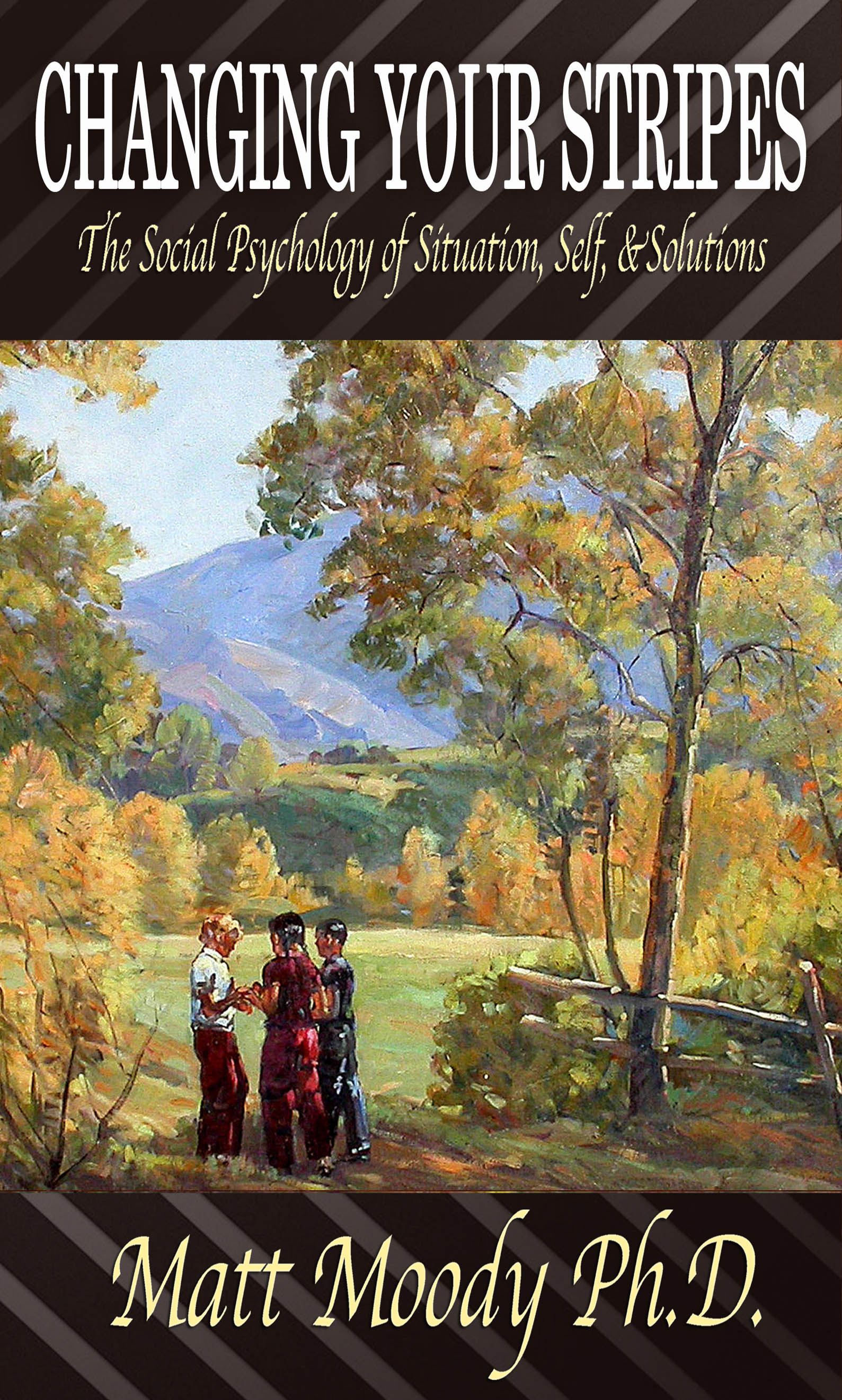
Changing Your Stripes is a
unique reference book that will help
you understand, . . . and solve all of
Life's ever-appearing problems
Here are more reasons to buy
Changing Your Stripes
Social Psychologist & Personal Advisor