
| Home | Ask Dr Matt | Call Dr Matt | Meet Dr Matt | Quotes | The Book | Answer Archive |
Excerpts from
"Changing Your Stripes"

Social Psychologist & Personal Advisor

from Dr Matt's Book
Changing Your Stripes
What's Your PQ?
by Dr Matt Moody
Changing Your Stripes offers insights that are routinely ignored by a plethora of positive attitude preachers; pundits who erroneously advocate you-can-choose-your-destiny doctrine with no limits. Indeed, you CAN choose your destiny, but there are constraining limits — as legendary trumpet player Louis Armstrong said:
"If ya ain't got it in ya, . . . ya can't blow it out."
Some simplistically argue that life's destiny unfolds according to one's choosing. But this assumption begs the question: "Why do people choose as they do?" Truth is, our words, thoughts and actions — which in turn reflect our choices — all these flow from us like water from a spring according to the core of our character, the condition of our heart. Jesus taught:
"How can ye, being evil,
speak good things? for out of the
abundance of the heart the mouth speaks.
A good man out of the good treasure of his heart
brings forth that which is good; and an evil man out of
the evil treasure of his heart brings forth that which is evil."
~ Matt. 12:34, Luke 6:45
This means, impatient people CANNOT really choose to be patient, especially under the press of provocation. For an impatient person, lack of free choice in a provoking moment is similar to the lack-of-freedom a skunk has when reactively spraying its foul smell — it happens reactively and without thinking. In the moment of provocation, an impatient person is anger-waiting-to-happen.
You can try to run from your troubles, but you cannot run from yourself. Wherever you go, . . . you bring yourself with you.
Within each of us are unresolved problems waiting-to-happen. Old unresolved issues that are like land mines longing to be stepped on, . . . anxiously waiting to explode. And these same old issues arise because of who we are -- the core of our character.
Our problems are portable; we bring them with us wherever we go! Without a fundamental change from our core, a change of heart, our built-in-troubles will eventually surface as we face future situations we have yet to master. This means, the same old creature might relocate to a new relationship with energetic hopes and optimistic anticipations, only to find the same stale issues arising again and again.

This broken-record routine will play its annoying tune over and over until you . . . Change Your Stripes!
"Mastering a challenging situation is
ultimately a matter of mastering yourself!"
~ Changing Your Stripes, 3rd Edition, page xv
Challenges must be met head on; for it is directly in our challenges that we discover our destiny. In the ever-appearing adversities of life, we can ever-increase in strength of character — a character that at mortal death is the only possession of which it can be said, "you took it with you." What you will take to the eternal world . . . is what you become!
"The Greatest Prize for Life's labors is not realized in material possessions or
impressive accomplishments, but in the progress of personal character.
You labor for your own becoming, it's your richest reward. Who You
Become is your greatest possession; make it your Masterpiece."
~ Changing Your Stripes, 3rd Edition, page 274
And here's the good news: You can determine your propensity to be provoked tomorrow by Changing Your Stripes today; you can become a person capable of patient and loving responses.
Provoke-Ability Quotient: What's your PQ ? Just as I.Q. measures intelligence, the P.Q. represents a person's propensity to be provoked. On a scale from 0 to 10, higher scores point to the tendency to be quickly and easily inflamed. A score of "10" would describe a maniacal RAGE-aholic. And lower scores would reflect a greater propensity for being patient when faced with provocation. Jesus would have a P.Q. score of "0", and the rest of us would have a descriptive score somewhere between 1 and 10.

You've likely heard the terms "reaching a breaking point" or "hitting hot buttons." These terms describe the threshold at which we literally CEASE to have character capacity sufficient to choose a patient reply.
And once people pass that breaking point, choosing rationally doesn't really happen.
Instead, patterns of reaction are "automatic" because of an entrenched history of previous choices -- notice I didn't say "an entrenched history ... of social influence."
In the pressing moment when the P.Q. threshold is breached, our exercise of will ceases to be "free will." This is true, because we are chained to behavioral consequences that flow from us according to choices made . . . in prior days. And such consequences happen according to the Lord's Law of Harvest — every human being will reap a harvest directly proportionate to their diligence, or lack of diligence.
The Law of Harvest explains the High PQ State of Insanity. A person can only reap "patience" if he faithfully plants the seeds of patience, and diligently nurtures their growth. Patience doesn't happen by default, by removing all provoking people and stresses from one's life. In fact, "patience" is planted and nurtured directly in the fertile field of opposition, where provoking people continually tempt us to react.
The Law of Harvest explains the human tendency of knee-jerk reactions, a.k.a., going nuts, flipping out, boiling over, blowing up, blowing your top, blowing your cool, acting whack-o, going berserk, in a tiff, in a tizzy, losing it, or raging, etc. In is vital to realize that these snap reactions are not consciously chosen in the moment, but are the harvest of prior planting -- prior choices.
Because these unwitting reactions flow from us unconsciously, it is commonly but erroneously assumed that an unconscious mind controls such "unconscious behaviors."
But this is not so! All unthinking reactions happen tomorrow, because of the seeds we sow today -- the conscious and intentional choices we make today. This is the Law of Harvest.
Because an infinitely wise God has created all humanity to be accountable for their choices, for this reason, the only mind human beings "have" is the one that they experience consciously. It is your conscious mind that intentionally plants the seeds that eventually sprout the knee-jerk behaviors that squirt out of you — unwitting eruptions proportionate to prior patterns of conscious choosing.
The "breaking point" I call the P.Q. threshold can also be visualized as a "squirting point." If you squeeze a lemon long enough, and hard enough, the lemon will spontaneously squirt at a particular point of stress. Changing Your Stripes means becoming the kind of creature that can patiently refrain from squirting under the press of stress!

The P.Q. Principle helps us understand that those who commit thoughtless crimes of passion — while they may indeed be insane in the direct moment of passion — they are still ultimately responsible and accountable for creating their knee-jerk insanity. In other words, while people who "act whack-o" may NOT have consciously chosen such "insanity" in the moment, they DID choose, line upon line one choice at a time, the eventual disposition from which their temporary insanity flows (see "Emotion as Energy-in-Motion" CYS, page 131).
So one conscious choice at a time we all choose the kind of creature we become; this means, from the consistent history of our prior choices, we each choose . . . our PQ's. And from the fountain of Who We Are flows our knee-jerk reactions -- reactions that we regret . . . in retrospect. But we remain responsible and accountable for the "fountain" that we are, and the behavioral "flow" that springs therefrom.
One Conscious Choice at a time,
You choose your Propensity to be Provoked.
You even choose your Propensity to . . . Insanity.
You are Responsible for the Person that You become.
You are Response-able for both your "premeditated" acts,
and the "thoughtless" reactions that flow from You.
~ Changing Your Stripes, 3rd Edition, page 50
PQ is also associated with the Everything-Happens-For-A-Reason assumption: Some people erroneously imagine that their current condition of character is happening for a Capital "R" Reason — it's part of God's grand design that happens by Fate, because that's just the way I am — when in reality your disposition is more likely the result of a lower case "r" reason: it's due to dumb decisions and poor planting on your part, sour sowing that yielded an unproductive harvest.
Another phenomenon that plays into PQ is that of Energy-In-Motion.
To understand the PQ Principle, you need to understand the way Cause & Effect occurs within the Behavioral Realm, as opposed to how Cause & Effect happens in the Physical Realm of our world.
All these ideas are explained in Dr Matt's book, "Changing Your Stripes."
Check Out Dr Matt's Spirituality/Provoke-Ability Measurement Scale: What's Your PQ?
Sold Exclusively
through this website
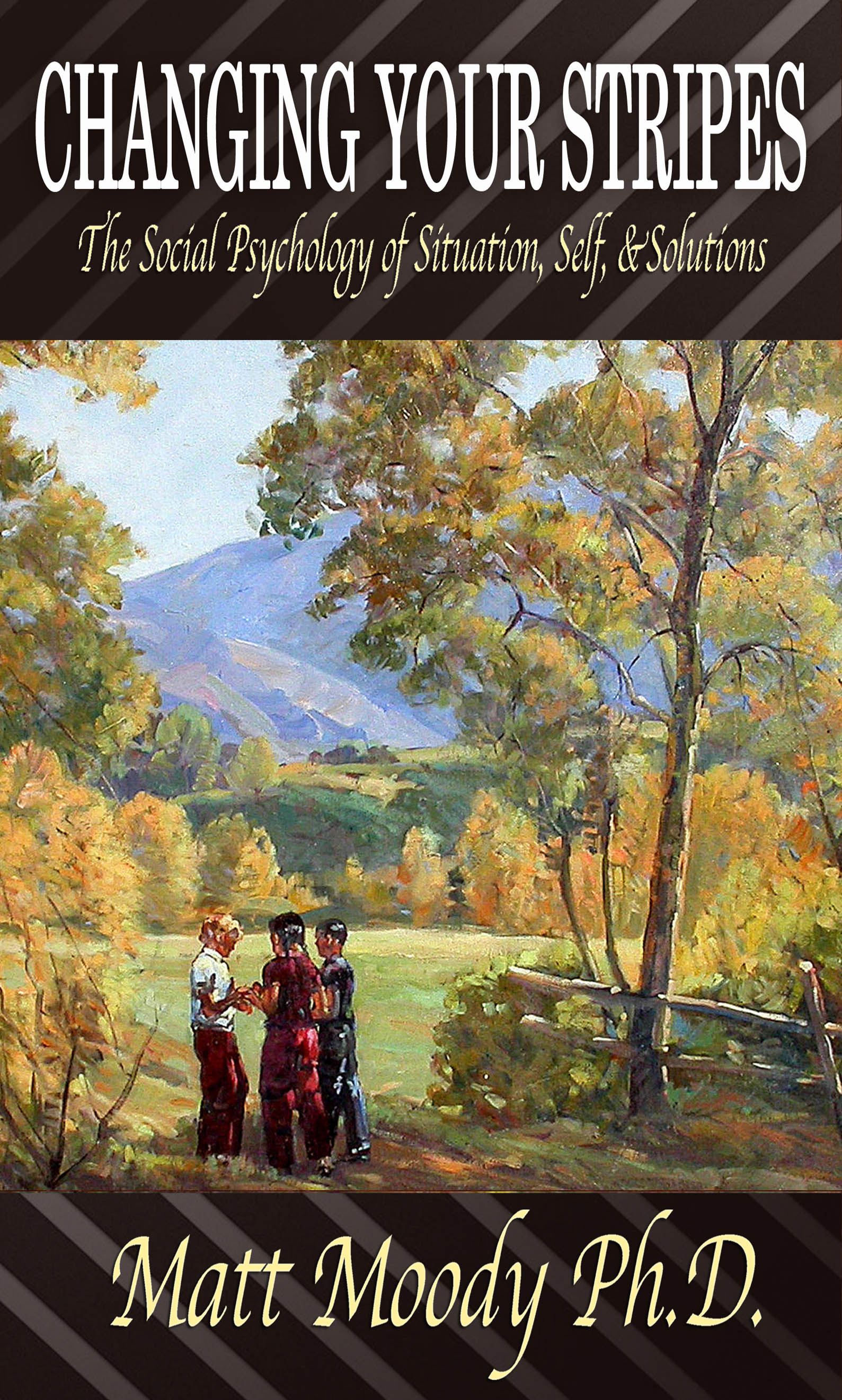
Changing Your Stripes is a
unique reference book that will help
you understand, . . . and solve all of
Life's ever-appearing problems.
Here are more reasons to buy
Changing Your Stripes
Social Psychologist & Personal Advisor