
Changing Your Stripes

Social Psychologist & Personal Advisor

Tell-Tale Signs of
Betrayal & Self-Deception
by Matt Moody, Ph.D..
Betrayal and Self Deception happen together: Betrayal occurs every time you and I move from the Light of Honesty into the Shadows of Dishonesty. As we move deeper into the Darkness of Dishonesty . . . clear vision decreases. These excerpts from Changing Your Stripes, will describe the dynamics of Self-Deception and then identify the Tell-Tale Signs of Betrayal — the initial act that always results in Self-Deception.
We devise and hang on to our emotional problems
for a purpose, a purpose more important to us than our happiness.
And we deceive ourselves about the fact that this is what we're doing. We participate
in the creation of our emotional troubles and deny we've had any part in it.
- C. Terry Warner.
When you are "in denial" . . . you are blind to your own blindness — you are Self-Deceived! The paradoxical condition to being "blind to your own blindness, Self-Deception, is a self-perpetuating bind: You're stuck in a rut . . . yet, you don't think you're stuck — but Reality says, you are!
When someone else in in denial, it's pretty easy to see their diversion! But how might you see your own blindness? And how can you see at all, when you are blind?
"Changing Your Stripes" breaks down the complexities of self-deception into simple, predictable patterns that consistently signal your own (or someone else's) departure from the Light of Honesty. A Light that inherently leads all humanity to be honest and do good. Moving from that Light into the Shadows of Dishonesty, is how Self-Deception is spawned: By going against your own sense of what is honest and good, you betraying your own intuitions of truth.
Self Deception: Slightly Blind Or Completely Oblivious? The “Fooling Yourself” phenomenon is manifest in varying degrees of distortion, ranging from Slightly Blind to Completely Oblivious. The Slightly Blind kind have an inkling in the back of their mind, that they need to be honest with themselves—but haven’t yet. The inner imbalance, to which they are slightly aware, keeps gnawing away. Though they may not openly admit it, they inwardly feel that they are “off track.” In moments of utter honesty, they know that they need to change.
In Contrast, people who are Completely Oblivious live life with an almost impenetrable blockage of blindness, a dense denial about every aspect of their personal problems. Usually they are the last to be aware of what’s going on. Completely Oblivious people have a problem, but they don’t “see” it—and you can’t fix nothin' . . . till you “know” it’s broke.
When blind and in betrayal, seeing a clear picture of your own bad behavior is difficult; this is because you’re viewing life from a perspective located within your body. Conversely, from an outside perspective, it’s actually easier to see others doing dumb things because their way of being and doing is openly apparent. In a similar way, this is why armchair quarterbacks can clearly “see” real quarterback blunders—in retrospect.
Just as real quarterbacks are actually IN the game, you are living life IN your body; thus, everyone can see your blunders better than you. When the play is already run, everyone can see a “better play”—in retrospect. This is where being Completely Oblivious comes in; this kind of blindness prevents a person from seeing the “better play” to run, even in retrospect.
* * * * *
When you don't know that you've got a problem, . . . that's a problem!
You can't solve a problem that you don't "think" you have.
Blind, Oblivious, and in Betrayal . . . you're Stuck!
.* * * * *.
The condition of being blind, oblivious, and in betrayal is self-perpetuating because the very mind that chose the betrayal bind in the first place, is the same corrupted mind that is TRYING to figure a way out (see Einstein's Mind Bind, page 175). Thus people who are slightly blind or completely oblivious quite naturally seek the wrong solutions. (Changing Your Stripes, page 155)
Tell-Tale Signs of Betrayal: All Your Troubles are in The JAR. Betrayal is a word to describe moments when a human being is out of harmony with his or her own sense of truth. As Shakespeare expressed, "To thine own self be true, therefore thou canst not be false to any man." Betrayal means being false to yourself, as well as to others. When you go against your own sense of goodness, you lose Life's inherent harmony. Inner conflict is created, and outward signs seep to the surface. Jesus taught, "every tree is known by its fruit." Corrupt fruit reveals a corrupt tree, and the fruit that grows on the tree of betrayal is readily identified.
* * * * *
Three Tell-Tale signs that YOU
are betraying your own sense of what is TRUE:
"All your troubles are in the J.A.R."
.* * * * *.
A thorough understanding of the tell-tale signs of betrayal can provide awareness sufficient to catch yourself and correct your course. The patterns are predictable and observable; they are signs central to the aim of Un-Doing! Seeing these signs in yourself will provide a huge clue . . . to what you need to Un-Do:
* * *
J = Justifying
A = Accusing
R = Resenting
.* * *.
Instead of owning response-ability, the person in betrayal typically tries to explain away the troubles at hand: Justifying self while Accusing others is the tell-tale pattern of those trapped in betrayal; further, betrayers become embroiled in Resenting emotions and rationalize, "because others have made me miserable . . . begrudging my abusers is what anyone would do in the same situation." Indeed, most would begrudge their abusers, but being average is not our aim. Changing Your Stripes is about excellence!
Whenever accusing and self-excusing words emerge, words laced with a resentful agitated edge, THEN you may know with certainty that a betrayal is in progress! The outward behaviors of the J.A.R. expose the inner imbalance of the heart, . . . inner conflict called betrayal.
Self-Deception: It's hard to See in the Dark. As the sun sets beyond the horizon, its light grows gradually dimmer. With the onset of darkness, the ability to see become increasingly impaired. Like physical vision, our spiritual vision is also obscured as we leave the Light of Innocence; for Out of the abundance of the heart, the eyes see. When our heart is out of harmony, . . . we cease to see clearly. Diminished vision is an unavoidable result of walking in the shadows of betrayal. Because we no longer see through innocent eyes, we perceive a different world before us. We see differently, not because the world around us has changed, . . . but because we have changed.
* * * * *
When I go against my own sense of Truth,
I go against myself, . . . I am false. Being false, the
way I experience the world is colored by my falseness:
I see darkness in my world, because of the darkness in me.
My thinking, my emotions, and how I behave
are all tainted by betrayal.
My search for solutions is skewed;
It is wrong, . . . . because I am wrong.
.* * * * *.
When caught in the trap of betrayal, we encounter the connected consequence of diminished vision; betrayal and blindness always occur together. People will not even attempt to correct a problem if they don't think they have a problem--yet they do . . . and are blind to it! Thus, having an intellectual awareness of the tell-tale signs of betrayal is a good start in "seeing" beyond the blindness. Intellectually identifying the tell-tale signs can be quite easy; the harder task is "seeing" the full implications of these outward signs and humbly admitting one's betrayal. Even though there is intellectual acknowledgment of tell-tale signs, yet we will continue to be blind as long as we remain in betrayal. Clear vision only comes with harmony of heart.
Einstein's Mind Bind. Impaired perceptions inevitably lead to flawed solutions. With clouded vision and confused thinking, betrayers cannot "figure" their way out of their problem. The reason why people do not, and sometimes cannot, find their way out of a problem is explained by a conundrum I call, "Einstein's Mind Bind." In short, you can't change your mind, . . . using the same mind that needs changing; neither can you fix a situation, using a mind that needs fixing. Here's how this bind of the mind . . . was stated by Einstein:
* * * * *
"We cannot solve our problems
at the same level of thinking which existed
when the problem was created."
.* * * * *.
Thus, in order to solve any problem, . . . a paradigm shift is required! A shift from the way of thinking that was capable of creating a problem in the first place, . . . to a way of thinking that can perceive a new perspective. Further, thinking that you can solve Life's most important problems with your "thinking" . . . is itself a problem. When confronted with a crucial issue, people often say, "I need to figure things out . . . I need a strategy." Using your head is a good approach for solving problems of algebra, but not for solving problems of anguish. Indeed, the mental mindset used to create a problem cannot be used to solve it! And as long as the head remains disconnected from the heart, betrayers will proceed to solve their problems in precisely the wrong ways; they will be beset with a blinding mental block that breeds more perplexity.
Being blind in the mind is a condition I also like to call . . . and so I do . . . The Migraine Mental Block: An ailment of a Head that pays no heed to the Heart. Again, being Blind in the Mind means: The head that thunk its way into a tangle cannot be used to think its way out of a tangle. But from whence comes a mindset capable of creating problems? It could be a function of shear ignorance, that's one possibility. The other possibility is that the mind bind is a function of betrayal.
Einstein's statement pertains primarily to intellectual processes, but there is usually a spiritual bind . . . that lies at the base of a mixed-up mind, . . . especially pertaining to problems of importance. In other words, the mind of a betrayer is incapable of clear thinking as to Life's most meaningful problems, as opposed to merely mathematical problems. People afflicted with a Migraine Mental Block are more prone to problem-making, than problem-solving.
In the experience of betrayal, inner conflict is characterized by repetitive thoughts that grind round and round in one's head: Figuring, conniving, strategizing, these are ways solutions are sought while in betrayal. Being inwardly unsettled, an urgent need to bring things back into balance is felt. Constant mental reruns represent a betrayer's attempt to bring things back into balance; but all such attempts are futile while trying to use the defective mindset that hatched the perplexity in the first place. Such repetitive mental dredging is also called "Obsession." Some might suggest you have a disease, a psychological disorder, . . . when really you're just doing and feeling dis-ease because of a spiritual dis-order: You've lost Life's inherent harmony.
When we go against ourselves, we cannot enjoy the contentment and clarity that comes with being true; instead, confusion of mind and emotion is our unavoidable lot. We experience conflict, both within ourselves and in outward relations. Nevertheless, lousy relationships, foulable feelings, and a migraine mental block do serve a purpose: They all let us know that we're not doing Life right!
* * * * *
Life is Self-Correcting.
When you are not doing Life right,
Life will make sure you are properly notified.
Inner and outer conflict is a clear clue,
that you . . . have not been true.
.* * * * *.
By choosing to resist the spark of inner goodness that guides, Life's inherent harmony is lost. Through our own conflicted thoughts and feelings, Life spontaneously lets us know that we walk in darkness. And when in darkness, we lack the clarity of vision that is amply enjoyed in the Light. Through darkened eyes we misperceive our world. Every solution contrived by our head ends up wrong, and will continue to be wrong as long as the head is out of harmony with the heart. When you're blind and in betrayal; the tell-tale signs of the JAR provide you, . . . a corrective clue.
Justifying
Self-justification has been a tell-tale sign of betrayal for a few millennia: "If I justify myself, mine own mouth shall condemn me" (Job 9:20). People who fall in the trap of betrayal feel an itching need to rationalize their contribution to a quagmire. Betrayers invest much time and energy into telling anyone who will listen, why they are justified in their attitudes, actions, and emotions; they assemble a self-justifying facade so they won't look bad, . . . when really they have been bad. They offer excuses for self-serving motives: To protect the image of "the Self as Advertised."
Betrayers tell a self-excusing story to convince themselves and others that they are OK and that blame lies elsewhere; they spin a tale that tries to make the wrong they are doing appear right, or at least not their fault. The very act of rationalizing reveals a betrayal. It is precisely because of inner imbalance that people get involved in a Justifying pattern. Justifying is only useful to those who are out of balance. Rationalizing has always been easier than admitting mistakes; it is the road of least resistance, and least effort. It is the crowded course traversed by a mediocre majority.
Telling Stories: Anxious vs. Honest. People who betray their intuitions of innocence have a story to tell! But not all who have a story to tell are betraying themselves. Some stories are just . . . stories. With no inflamed emotion, some stories explain events and occurrences with straightforward frankness; no blame, no irritation, no resentment exists in the telling of an honest story. It is a story that explains and may even entertain. This type of story will mostly go away the following day . . . for it has no reason to stay. That is, unless you really like it, then you might file it away . . . and enjoy it on another day.
The anxious story, in contrast, is more than a simple explanation of things and happenings: It's an unsettled story that arises from a mire of internal conflict. It tends to be told over and over, because the teller of the anxious story finds no emotional closure in it. Thus, neither the story nor the flustered feelings go away in coming days, instead, reruns and sequels continue, and such repetitive "broadcasts" reveal the inner conflict of the producer/storyteller.
There are two fundamental kinds of Stories that people tell: One Honestly and Simply Explains and the other Anxiously Excuses and Accuses.
* * * * *
Two types of Stories:
One indicates Truth, the other Betrayal.
The Anxious Story is self-excusing and accusing;
It harbors Resentment and oozes with Unsettled Emotions.
Because the story hides a lie, . . . there is no peace or closure in it.
Many sequels arise from an Anxious Story; It can become complex
and sprawling. It continues in a new day, . . . and does not go away.
Reruns to be told tomorrow.
The Honest Story, in contrast, Accuses no one,
Resents no one, is not Edgy or Irritated,
and goes away . . . the next day,
It has no reason to stay.
.* * * * *.
Because the anxious story yearns to appear convincing, it seeks to be backed by facts; it needs to be lined with logic. The anxious story clings to factual evidence to compensate for the inner insecurity of the storyteller. The anxious story requires airtight logic to make secure, an inherently insecure story.
* * * * *
Because the Anxious Story is inherently insecure . . . from its core,
It desperately clings to superficial facts and alluring logic.
.* * * * *.
Conversely, the honest story is more or less succinct and needs no long, involved logic. Because they have no inner turmoil to resolve, people who tell an honest story speak candidly with no agitated edge of emotion. The honest story does not try to manipulate or pretend, and it may even be a little awkward or goofy. It is not premeditated or polished, because honest storytellers have no motive to appear impressive. The Honest Story will BE, whatever it IS because "that's the way things happened."
* * * *
People who have Nothing to Hide, . . . Hide Nothing!
.* * * *.
Those who speak honestly from the heart do not premeditate impressive presentations or calculated strategies. But not all anxious stories are created in a calculated way: Sometimes the story streams out spontaneously . . . with no forethought to finagle; it just flows naturally like venom from a snake. And when "snakes" live a lie for a long period of time, they can get good . . . at doing bad! Even though superficial performances are imperfect at heart, impressive appearances can be perfected with practice: Practice makes perfect appearance! A wolf's deceitful motives can be disguised by sheep's clothing tailored to skin-deep perfection. Thus anxious stories will not always "appear" anxious, but will still be defective at heart.
Impressively polished stories can still expose unethical inner motives through another tell-tale sign: The tendency to tell the story over and over again. Because the anxious story is told primarily to protect the image of the self as advertised, by being stuck in the story, people not only reveal their betrayal of truth, but they also spill their selfishness.
Stuck in the Story. With each re-telling of an anxious story, the betrayer hopes that the next telling will dispel unsettled feelings; but predictably, uneasy emotions remain. Running a story over and again in your head, as well as constantly telling that story to others, is a repetitive rut I call . . . "Stuck in the Story." It's very easy to recognize people who are stuck in the story:
* Anxious emotions are displayed in the storytellers,
* The elements of the J.A.R. emerge, and
* They can't quit telling the story, . . . they just won't SHUT UP!
The truth is that anxious emotions never go away by rationalizing, instead inner conflict is only cured through recovery--a return to innocence. As Stephen Covey concludes, "you can't talk your way out of a problem that you behaved your way into." This means that betrayers must back out of the very behaviors that initiated the inner imbalance. Betrayers must un-do dark deeds!
Thinking that rationalizing might bring relief is indicative of a betrayers distorted mentality. Strategizing and calculating cannot solve the problems of a defective heart.15 Mental machinations can only shape and prune the outer appearance of problems, but cannot cure a corrupted root. Solid solutions that root out problems from their foundation require more than superficial pruning; sound solutions require a change in whole behavior--motives, emotions, words, and deeds. And that fundamental and holistic change begins with owning response-ability for the behaviors that correlate to inner imbalance, . . . and then un-doing those dark deeds. Again, tell-tale signs provide a corrective clue . . . to what you need to Un-Do.
Vote-Getting. Yet another "red flag" that signals betrayal is vote-getting. Being inwardly unsettled, the betrayer seeks solace by securing votes from others; hoping to make secure . . . a story that is insecure . . . from its core. If the justifying story is superficially plausible, then support and sympathy may be gleaned, yet the betrayer finds no inward relief. Even if a betrayer "wins the popular vote," . . . that person "wins" no inner harmony.
* * * * *
In matters of Personal Peace,
the only Vote that counts is the one registered
in the Ballot Box of the Heart.
.* * * * *.
People who are Being True are not fretfully engaged in a vote-getting campaign; they do not solicit votes in support of an anxious story. When people have harmony of heart, they offer no excuses and have no story to tell--at least not one that is laced with self-justification, accusation, and resentment. The absence of a need to tell a story of excuse points to people who are most likely Being True. They have no itching need to justify because there is no inner imbalance to resolve.
When people are Being True there is no case to prove, no ax to grind, no evidence to offer, and no votes of support to seek. This is because there is no case, no ax, and no argument, and no campaign for seeking the popular vote, but there IS . . . personal peace. In contrast, When a person betrays the truth within, . . . there IS a case to prove, there IS an ax to grind, there IS evidence to offer, and there IS active lobbying for votes.
Even though a justifying story may be airtight and firmly supported by solid facts and convincing logic; even though a large volume of votes may be cast in support of that story; and even though a betrayer may be sincerely convinced that the story is true; . . . if the elements of the JAR are present, one can confidently conclude that the story and the sincere feelings are false and that someone has been fooled! People who are fretfully in "need" of winning "the popular vote" reveal their inner imbalance due to betrayal. Seeking for the popular vote is a attempt to try and convince yourself that the anxious story you tell is the truth . . . when it's really contrived.
* * * * *
If you have to try to convince yourself,
that means . . . you're not convinced!
.* * * * *.
An Invitation to a Justification: Asking Why? When someone does something bad, it is common for people to inquire as to "why" the dark deed was done? This is particularly a tendency when watching children make mistakes. Observers ask, "Why . . . did you do that?" Through experience, mistake-makers learn from an excuse-making society . . . that if they conjure up a good story . . . they might "get off." But in truth, there are no excuses, or justifications, that can make bad behavior . . . into good behavior! Thus, when asking the doer of a deviant deed "why" . . . you can expect a justifying "lie."
* * * * *
Ask people Why . . . and you invite them to Lie!
When people are in betrayal, asking "Why"
simply leads to a Self-Justifying Lie.
.* * * * *.
In the question of "why" . . . there lives a "lie"--or at least the potential of a lie, . . . a temptation to a lie. Saving the "face" of the self as advertised is usually the reason we tell self-justifying lies; excuses are given to preserve and defend the claims of an egocentric "ad" campaign. And what is the alternative? To Be True and resist the superficial facts that fool, the alluring logical facts that make our story sound right . . . when it's not right. The alternative to "justifying" is to move from the shadows of betrayal and return to the Light--the Light that warms us and assures contentment and peace. Personal calm and clarity comes through Recovery of inner harmony, and not by outward Rationalizing. Satisfying solutions flow from the gentle whisperings of the Heart.
Accusing
A False Solution: Blame as Balm. In spinning self-justifying stories, we portray someone or something else as being at fault. But what good does this do? To think that Blaming Others might bring relief is the accuser's misleading illusion! Even when others are completely blameworthy, motives of revenge, resentment, and rationalization only serve to poison the heart of those who harbor inflamed feelings. In the name of justice and closure, betrayers embark upon a crusade of accusation against offenders. But when such a crusade is cankered with accusing emotions, blame brings no healing balm to the wounded soul. Instead, fretful feelings make the wound wider! The comforts of closure cannot be had while harboring unsettled emotions.
Blaming Situations is equally fruitless! It may be tempting to think . . . "If only I could escape my sad situation, then I could be happy." But a change in circumstance is rarely a favorable fix when one is in betrayal; for EVEN IF you move to some enchanted island (and you haven't yet recovered), you will end up bringing your old unenchanted self with you; thus, you bring to a new location your same old bag full of problems. Old habits die hard even in new locations. Like a mouse trap, . . . your propensities are ready to snap; and when others bite the bate, snapping reactions . . . just waiting-to-happen . . . will erupt out of you even on some enchanted island.
Because Life is a Set Up, you can expect selfish people and distressing events to impact your Life. Life is filled with frustrating twists and turns that unexpectedly arise: Get used to it, get over it, and get on with it! That's Life! While such stressful constraints will explain the Set Up to which you are exposed, if you would Be True from this day forward, you won't point to those constraints for excuse--you will live without accusation.
Playing the blame game is a major obstacle to recovery. Living Life to the heights of happiness means focusing upon the "responses" that come out of you, especially when the going get tough. Character is tested at the edge of adversity.
* * * * *
There are bad things that happen
to me, and there are bad things that I do.
The bad that I do . . . IS my failure to Be True.
By Accusing others I Betray the Truth.
.* * * * *.
So, you might as well give up blaming, . . . and quit complaining too! Unless all accusation ends, in both word and emotion, you will never consummate the comforts of closure. In contrast, there is comfortable closure in embracing Inner Liberty, and there is much closure in having compassion even for offenders. The person with an accusing heart cannot access the pleasing possibilities that come with compassion.
Resenting
Because other people have wronged us--or we imagine that they have wronged us--therefore, our plight must be their fault. We falsely conclude that we are justified in harboring hatred towards offenders. While perpetrators may be directly responsible for causing abrasions and intrusions beyond the perceptual participation and choice of the abused, yet those victimized by misfortune still have Response-Ability; they author all responses of word, deed, mind, and emotion--to include the response called resentment.y:
* * * * *
When I am False . . . I feel
Tension, Agitation, Disharmony.
My Resentful Emotions signal falseness.
When I am True, . . . I am at Peace;
the Peace that flows freely
signifies Harmony.
.* * * * *.
Re-Sending Negative Energy. Resenting other people, or situations, is a re-occurring activity: After someone has been mistreated and the opportunities of a new day arise, instead permitting fresh feelings to invigorate, the resenting person engages in re-sending negative energy. Choosing to re-send resentment is today's decision that squashes tomorrow's opportunities.
Those who re-send hateful energy may hold in their head an erroneous idea, that harboring hateful feelings sends psychic arrows back to abusers; they may imagine that arrows of anger will somehow pierce and punish offenders. This idea is completely and paradoxically . . . false! The re-sending of resentment does not send psychic arrows out, but sends out boomerangs . . . that come back; thus returning all the bitterness sent . . . and "re-sent." (Surely, this is the etymology of the word re-sent-ment).
Every resentful seed sown returns a bitter harvest; this is a consistent Law of Life. When resenting, you sentenced yourself to the hard labor of dragging the heavy load of bitterness behind. The act of resenting tethers you to yesterday's misery, and keeps you from today's opportunity. Re-senting is a re-occurring waste of time and energy. The Law of the Harvest guarantees that offenders will eventually receive wages for their hurtful works, but the wages need not be paid via resentful retaliation from the offended. When offended, oppressed, and victimized individuals try to exact "pay back" for their abuse, they execute a self-inflicting irony:
* * * * *
Resentment is the Poison that You Drink,
while expecting your offenders to die
from the Poison that You Drink.
.* * * * *.
Resentment Retention Time Revisited. Even though harboring resentment is like shooting yourself in the foot, people have a penchant for "hanging on" to yesterday's offenses. The Resentment Retention Continuum is a way of locating the "politically approved" length of time a person should feel hurt and humiliated after being offended; . . . just how long should resentment be retained? 2 minutes . . . 2 hours . . . 2 days . . . 2 weeks . . . 2 months . . . 2 years . . . or 2 decades? Remember, Resentment Retention Time needs to parallel the nefarious nature of the alleged offense. Keeping resentment within a "politically approved" time frame may be challenging for people possessing a High PQ; they will naturally want to keep resentment ruminating in their sour bellies for a longer period of time than even the "popular vote" may approve.
One particular client I worked with was a Gold Metal Resenter. She accomplished a stunning feat of Resentment Retention that reached back four decades, and bridged the bearing of five children. Forty years later, she was still squawking, fussing, and yammering about offenses perpetrated in her teenage years. If she had reached back any farther into her resentful memory, she might have resented her mother for bearing down too hard in the delivery room!
Her record-setting resentment was a function of Einstein's Mind Bind: She wasn't seeing or thinking straight because of betrayal, but also, this client's Migraine Mental Block was further fed by a fallacious Freudian doctrine: "You're weird today because of something that happened yesterday." Because she bought into some erroneous conclusions of cause & effect psychology, she assumed that she needed to go back to the start of the causal chain: The beginning moments when she met her husband and the alleged torment began.
But the truth is: The only "chain" that encumbered this woman was the one that she'd been actively knitting for forty years; the heavy chain of resentment. With each dawning of a bright "new" day, she willfully shackled herself to yesterday's dark and dreary memories; for an incredible 14,600 days, she chose misery . . . over opportunity. (see V. Frankl's quote, page 12)
But the truth is that yesterday's offenses were not as horrendous as she portrayed them to be . . . in reality, that's simply the way she stretched her story to justify her present-day pain--her self-produced pain. Since her present day pain . . . was enormous by claim, she needed a very large story. Our Gold Medal Resenter was so deeply invested into maintaining today's suffering, that she had spun an anxious story of encyclopedic proportions. To say she was story-stretching is an understatement. But whether her story was loaded or limited is actually irrelevant . . . she HAD a "story" . . . PERIOD. The tell-tale sign of justifying was more than conspicuous.
Week after week, I watched this client go through her justifying gyrations to lobby for longer resentment retention time. A task that became increasingly difficult because her husband was not being offensive in the present, so the only fodder she had to blast from her accusing cannons was in the distant past--whether real of imagined. This is what happens when maintaining a self-justifying story becomes more important than having personal peace! C. Terry Warner describes this paradoxical position:
* * * * *
"We devise and hang on to our emotional problems
for a purpose, a purpose more important to us than our happiness.
And we deceive ourselves about the fact that this is what we're doing.
We participate in the creation of our emotional troubles
and deny we've had any part in it."
.* * * * *.
When confronted with her conspicuous resentment hoarding, she explained, "You don't understand, when those airliners hit the twin towers in New York, a huge pile of rubble was created that takes years to clean up, and build back." Her 9/11 analogy was a masterful piece of persuasion and justification; a story that would have undoubtedly garnered much sympathy from those who have bought into the assumptions of It's-Not-Your-Fault Psychology. But I knew that her slick logic was a rationalizing cover story to hide her betrayal. Further, she defended the image of the self as advertised with ferocity. And what was that image you ask? The image of a victim: "I could be happy if it weren't for my husband." The self as advertised is not just a glossy facade, that's only one version . . . it's any facade that we sell to others for self-serving purposes.
After literally investing a lifetime into blaming and resenting her husband, her only way out was to admit that she had been wrong for forty years; . . . she was in a prideful bind. Four decades later, admitting her error and coming clean was a behemoth hunk of humble pie too humungous to swallow. So, she stuck TO her story . . . for she was stuck IN her story!
Like most who claim victimhood, she didn't think she was choosing the self-made misery of resentment. Indeed, self-made victims do not see their emotional distress as a choice, for the very definition of "victim" means "someone has done it to me." Hence, the resentful response is seen as a natural occurrence. Betrayers rationalize: "This is how most people would respond when mistreated . . . it's normal behavior." Indeed, "normal" . . . as in "average." Most people do indeed respond with resentment when mistreated, and "most people" ARE members of the mediocre majority--people who are not aiming for excellence . . . but aiming for excuse.
A true victim experiences suffering and loss beyond any perceptual participation that he or she might bring to a misfortune. This is precisely why the beginning of this book explained the distinctions between cause and constraint--to clear the confusion. Thus you may be a victim of physical harm to person or property, but you can never be a "victim" of spiritual harm--spiritual suffering of soul only happens with your permission and participation. (see 1st Cor. 10:13).
For victims of tragedy to escape suffering of soul, they must fully accept the fact that resentment is an emotional response originating from the "resenter," and therefore, must own that they author those resentful emotions. But here's a news release that will shock some: Other than necessary physical pain that may be felt in the body due to intrusive, tangible impacts, the continued emotional suffering that victim's blame upon yesterday's abuse IS the resentment harbored by an accusing heart. For it is from the "good treasures" (or bad treasures) of the heart that the mouth speaks, . . . the mind thinks, . . . and the eyes see. When one sees darkness in days gone by, . . . it is due to the darkness in the perceiving person--because of the bad treasures of the heart.
Resentment IS Today's Trauma. Paradoxically, people actively participate in the creation of their own unsettled emotions and then . . . deny their contribution; a denial that manifests via blame, a denial that flows from a mind that is blind. Because of a Migraine Mental Block that obscures clear vision, betrayers cannot "see" that today's emotional pain IS the self-made misery of harboring resentment.
From the constraints of Situational Suffering come necessary heartache that true victims endure in direct moments of affliction. Thereafter, optional misery emerges as the dust of a difficulty settles and a person stands at a point of transition . . . a junction of choice: To either keep or discard Inner Liberty. When the decision to "discard" Inner Liberty is made . . . people paradoxically put themselves in the bondage of a self-made emotional prison.
When I speak of the "dust of a difficulty" settling, I am acknowledging that it takes time to work through a tragedy. But that working through process can be done with the Light of Innocence leading the way; a Light of Hope that pierces all darkness and despair. Working through a tragedy with able assistance of Inner Light means that drinking the poison of resentment can be skipped entirely. Further, Frankl suggests that a person need not wait for the ending of a trauma to invoke Inner Liberty.
* * * * *
Waiting for the dust of a difficulty to settle is unnecessary,
I can fully embrace Inner Liberty immediately,
even amid an aggravating event.
.* * * * *.
Keeping Inner Liberty while directly in a difficulty . . . doesn't mean that all pain disappears, but it does mean that Self-Inflicted Suffering is not added to, and heaped upon, the necessary distress felt when directly in a difficult situation. In other words, one will not experience suffering of the soul even if physical pain is present. Faithfully enduring outward physical afflictions, while still being able to embrace inner peace, is a principle taught by the Apostle Paul:
"For all things are for your sakes, . . . For which cause we faint not; but though our outward man perish, yet the inward man is renewed day by day. For our light affliction, which is but for a moment, worketh for us a far more exceeding and eternal weight of glory; while we look not at the things which are seen, but at the things which are not seen: for the things which are seen are temporal; but the things which are not seen are eternal" (2 Corinthians 4:15-18).
Amid outward afflictions, the Division of Response-Ability Principle applies: What Comes out of You . . . is Yours! And the condition of your character is revealed by how you respond through tough times!
* * * * *
Harboring Resentment is a form of Self-Inflicted Suffering.
Self-Made Misery arises from my inability to keep Inner Liberty.
I inflict myself with discomforting consequences as I fail
to hear and heed the whisperings of the Heart.
.* * * * *.
Being consumed with agitated emotions of resentment, anger, or accusation is a natural consequence of losing Life's inherent harmony. Because perceptions are distorted via a Migraine Mental Block, betrayers erroneously imagine that they can rationalize their way out of inner anguish. And as we have learned, telling justifying stories is only useful to those who are “out of balance.” People who live in harmony with Inner Innocence have no story to tell, . . . because they have no inner imbalance to resolve. When a person is Being True . . . there is no case to prove, no ax to grind, no evidence to offer, and no votes of support to seek; for there is no case, no ax, and no argument, . . . but there IS . . . inner peace.
Twenty Buck will Buy you the Best Self-Help Book on the planet! Changing Your Stripes!
Sold Exclusively
through this website
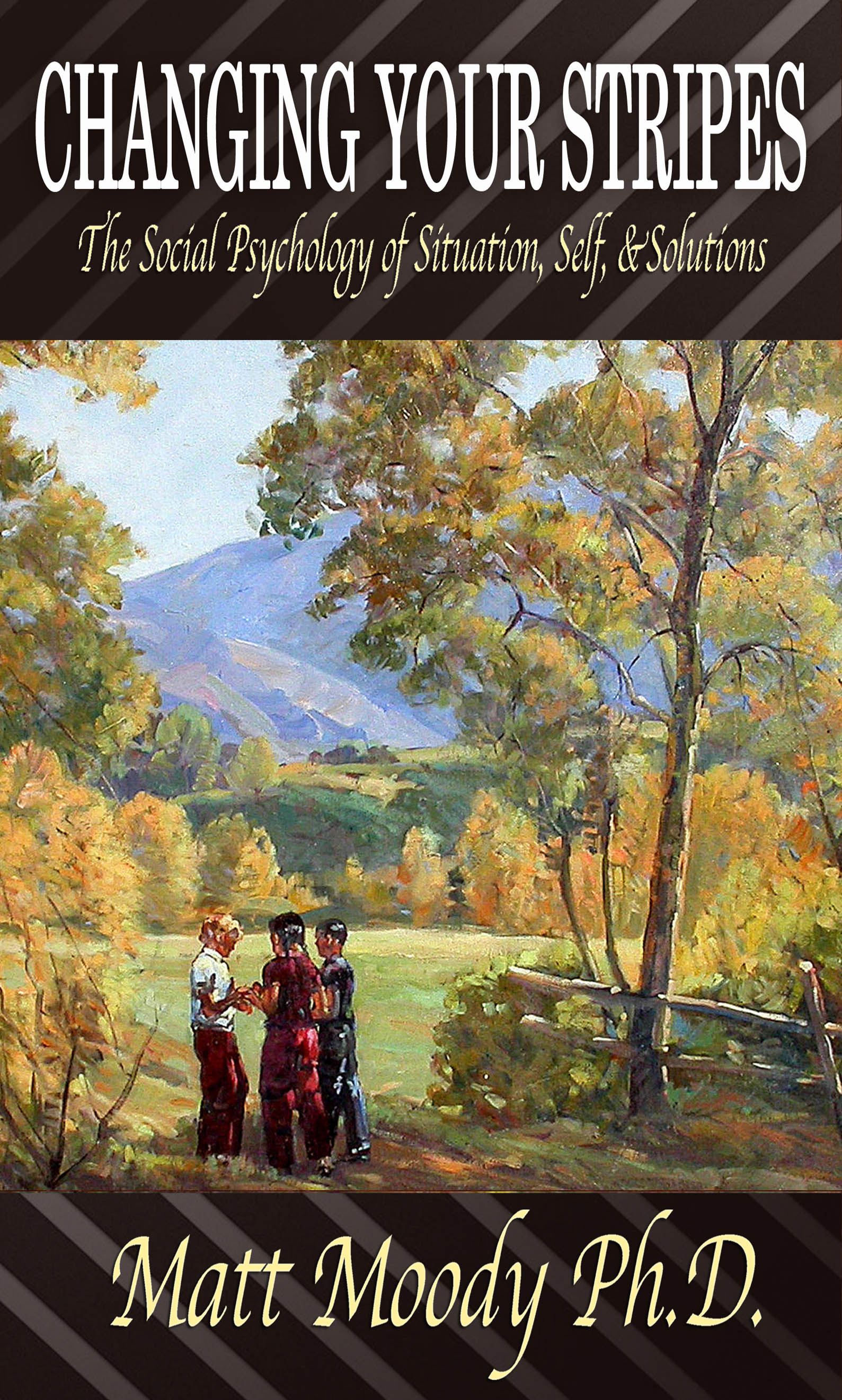
Changing Your Stripes is a
unique reference book that will help
you understand, . . . and solve all of
Life's ever-appearing problems.
Here are more reasons to buy
Changing Your Stripes
Social Psychologist & Personal Advisor